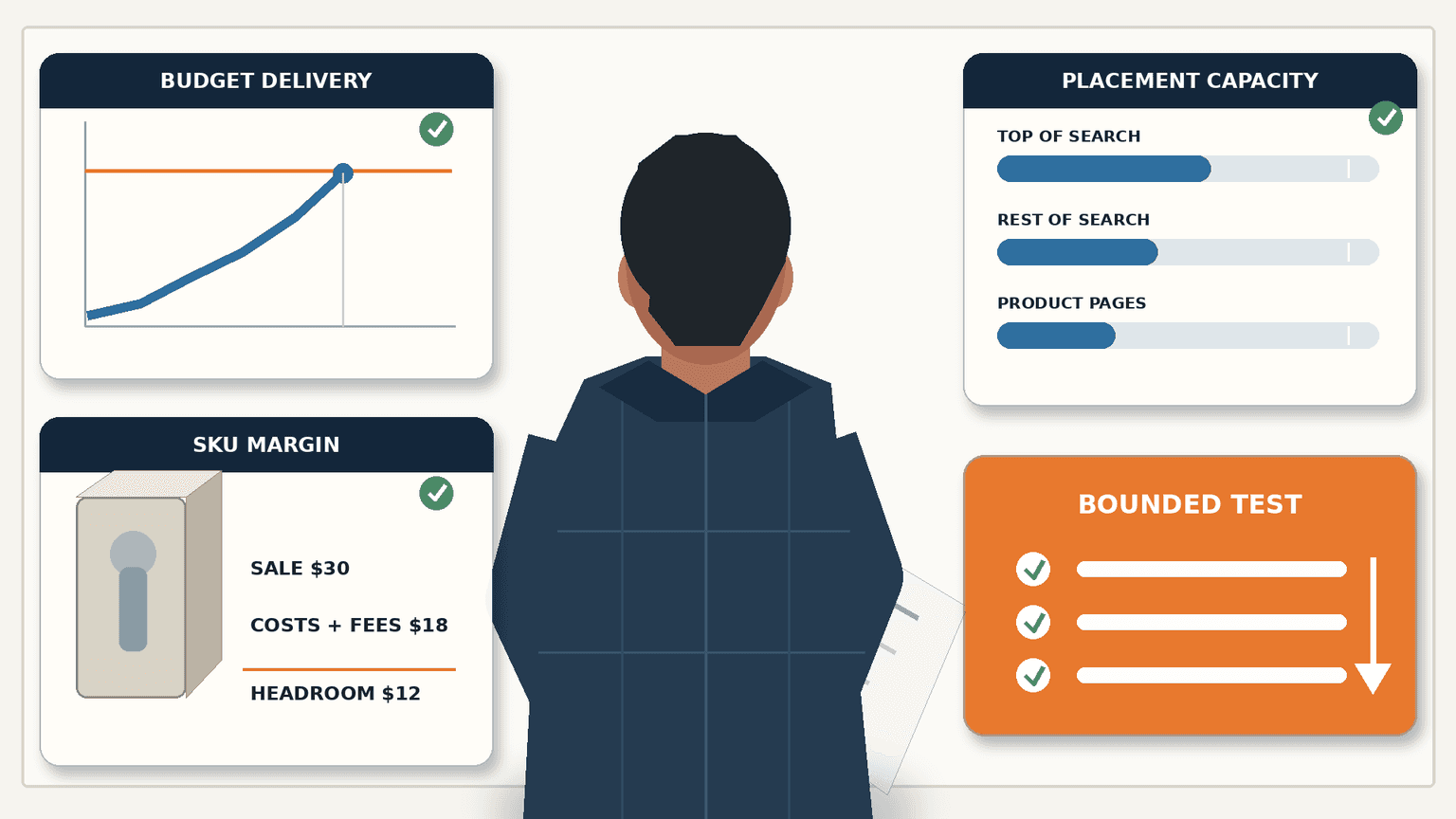
A profitable-looking Amazon PPC campaign is not automatically ready for more budget.
Before you scale it, answer three questions:
- Is budget actually limiting delivery?
- Is there valuable impression and placement capacity left to buy?
- Can the product afford the next sale at the likely marginal ad cost?
If any answer is no, raising the daily budget may do nothing or make a good blended ACOS worse. The campaign could be running below its budget already. Its best placement may be close to saturated. Or the advertised SKU may have too little contribution margin to absorb more expensive traffic.
That distinction matters because the next dollar does not necessarily perform like the average dollar already spent.
Start by finding the real constraint
Use this quick classification before touching the budget:
| Diagnosis | What the account shows | Better first move |
|---|---|---|
| Budget-constrained | The campaign runs out of budget while qualified traffic still converts within the SKU's target economics | Test a bounded budget increase |
| Opportunity-constrained | The campaign has little valuable share left, weak placement economics, limited target volume, or poor relevance | Reallocate, restructure, or find new demand |
| Economics-constrained | Added sales are likely to exceed the SKU's acceptable acquisition cost | Hold or reduce spend; fix margin, conversion, or the offer |
A campaign can have more than one constraint. Fixing the budget ceiling will not repair a bad placement mix, and low impression share will not repair thin margins.
For the broader recurring workflow around bids, search terms, and account maintenance, see our Amazon PPC campaign optimization guide.
Gate 1: prove that budget is limiting delivery
Amazon defines an out-of-budget campaign as one that has exhausted its daily allocation and is no longer eligible to show until the daily budget resets. Its Budgets page may also show average time in budget and estimated missed impressions, clicks, or sales. Amazon says those missed-opportunity figures are model-based estimates, not guaranteed outcomes. [S1]
That makes "out of budget" useful evidence, but it is not automatic permission to scale.
Check:
- whether the campaign regularly spends its full budget;
- what time of day it stops serving;
- its percentage of time in budget;
- whether the converting traffic remains inside the target economics;
- whether enough time has passed for attributed orders to appear.
Amazon's own guidance separates converting campaigns that exhaust their budgets from nonconverting campaigns that do the same. The first may justify more budget. The second needs work on bids, targeting, or the product detail page before it gets more money. [S1]
The opposite case is simpler. If a campaign is not spending its current budget, raising the ceiling cannot force additional delivery. Look at bids, relevance, eligibility, search volume, inventory, and Featured Offer health instead.
One Seller Forums thread captures the failure mode neatly. The seller reported increasing a campaign from $60 per day to $100, $200, and eventually $800, only to have the larger budgets disappear rapidly. Replies focused on bids, search terms, and negatives rather than another budget increase. It is one anecdote, not a benchmark, but it shows why "spends the budget" and "deserves the budget" are different findings. [S2]
Gate 2: check impression and placement capacity
Once you know budget is binding, ask what additional traffic the campaign is likely to buy.
Amazon's Search Term Impression Share report shows the percentage of Sponsored Products impressions your account captured for a search term, plus its impression rank relative to other advertisers. Amazon describes a 90-day report lookback with daily or summary units. The same support page separately tells advertisers to review impressions received over the last 30 days. Those are different statements, not competing definitions: one describes report availability, while the other is review guidance. [S3]
Search Term Impression Share is account-wide for each search term. Low share can reveal room to compete on a valuable query. It cannot tell you whether the added clicks will be profitable.
Top-of-search impression share is narrower. It measures the percentage of eligible first-page, top-of-search impressions a campaign received, and Amazon connects the metric to placement bid adjustments. [S4]
Read those share metrics beside the Sponsored Products placement report. Amazon separates top of search, rest of search, and product pages, with performance fields such as impressions, clicks, CPC, spend, sales, orders, and ROAS. [S5]
Now the useful questions become more specific:
- Which search terms produced the profitable orders?
- Is impression share low on those terms, or only on weak ones?
- Which placement produced the campaign's historical efficiency?
- Is blended ACOS hiding poor rest-of-search or product-page traffic?
- Would more budget preserve the current mix, or simply let the weaker placement spend for longer?
- Would a bid or placement adjustment be more precise than a budget increase?
Do not turn this into a universal "top of search is best" rule. Placement performance varies by product, query, bid, competition, price, reviews, and conversion rate. Historical reports describe what happened under the old conditions. They do not promise the next auction will behave the same way.
High impression share also does not mean the entire account has nowhere to grow. It may still expand through new search terms, product targets, ASINs, or placements. It only tells you that buying much more of the current opportunity may be difficult or expensive.
Gate 3: calculate margin headroom outside the ad console
ACOS and ROAS do not include the full product P&L. Before scaling, calculate what the SKU can afford after landed product cost, Amazon fees, expected returns, discounts, and other variable costs.
A practical starting point is:
Pre-ad contribution per unit = selling price - landed product cost - Amazon/referral/FBA fees - expected returns, discounts, and other variable costs
Then:
Breakeven ACOS = pre-ad contribution per unit / selling price
Suppose a product sells for $30. Landed cost is $10 and Amazon fees are $8. Before accounting for any additional variable costs, pre-ad contribution is $12, so the simple breakeven ACOS is 40%. This is a hypothetical teaching example drawn from a practitioner explanation, not a Clickbringer client result. [S6]
Breakeven is not always the operating target. A mature SKU harvesting profit may need an ACOS well below breakeven. A launch or rank push may deliberately tolerate a higher figure for a defined period. Brand defense, customer acquisition, and inventory clearance can each justify different targets.
The important comparison is not historical blended ACOS versus breakeven ACOS. It is the expected marginal ACOS of added spend versus the product's chosen target.
Also check the constraints that ACOS misses:
- inventory cover and replenishment risk;
- cash-flow limits;
- price and promotion changes;
- conversion readiness;
- Featured Offer and advertising eligibility;
- the product's actual objective.
Scaling a low-ACOS campaign into a stockout can be an expensive way to create an inventory problem.
Run a bounded scale test, not a victory lap
If the campaign passes all three gates, increase spend as a controlled test.
- Record the baseline: budget, bids, placement adjustments, spend, orders, sales, ACOS, CPC, conversion rate, time in budget, and the relevant share metrics.
- Choose one main change. If you raise budget, avoid simultaneously rewriting bids and targeting unless the structure itself is the problem.
- Define the product-level target and stop condition before the test starts.
- Allow for the account's attribution timing. Do not judge a structural change from a partially matured sales window.
- Compare the added spend and added sales with the baseline. Blended performance can remain attractive while the incremental portion is deteriorating.
- Keep, reverse, or redirect the increase based on marginal economics and placement quality.
This is slower than clicking Amazon's recommended budget. It is also much easier to diagnose. When budget, bids, targeting, and placement multipliers all change together, the campaign becomes a small haunted house: money goes in, noises happen, and nobody can prove which lever moved the result.
When not to scale
Hold the budget increase when:
- the campaign does not spend its current ceiling;
- it spends out but does not convert within the required window;
- valuable search terms already have high share and no clear expansion path;
- the profitable placement is carrying a weak blended campaign;
- added traffic is likely to exceed the SKU's target acquisition cost;
- the listing, price, inventory, or Featured Offer status is unstable;
- the proposed change has no baseline or stop condition.
A winning campaign should earn the right to scale. Good historical ACOS gets it into the examination room. It does not sign the discharge papers.
Frequently asked questions
Does low impression share mean I should increase my budget?
No. Low share means your account captured a smaller portion of the available impressions for that search term. Budget may be the constraint, but bids, relevance, eligibility, competition, or weak conversion economics may be responsible. Diagnose those before adding spend. [S3]
Should I increase the budget whenever Amazon says a campaign is out of budget?
Not automatically. Amazon's missed-opportunity figures are estimates. Confirm the campaign is converting, the constrained traffic is valuable, and the SKU can afford the likely marginal cost. [S1]
Is high top-of-search impression share bad?
No. It can mean you already capture much of an eligible placement. That may be excellent. It also means further growth from the same placement could become harder or more expensive, so look for product-level profitability and other expansion paths. [S4]
What is the safest way to scale Amazon PPC?
Prove the budget constraint, verify valuable auction capacity, calculate product-level headroom, and make one bounded change with a baseline and stop condition. There is no universal percentage increase that is safe for every campaign.
Scale the constraint you actually have
More budget helps when budget is the binding constraint and the next traffic remains worth buying. It cannot manufacture demand, repair a weak placement mix, or create margin that the product does not have.
If you are unsure whether an account is budget-, opportunity-, or economics-constrained, a free Amazon PPC audit can map the bottleneck before you raise spend. See how disciplined account decisions translate into results for Amazon brands, or explore Clickbringer's Amazon PPC management service for ongoing bid, budget, targeting, and placement management.
Sources
- [S1] Amazon Ads: Sponsored Products budget basics and best practices
- [S2] Amazon Seller Forums: Campaign's always out of budget in a few minutes
- [S3] Amazon Ads: Search Term Impression Share report for Sponsored Products
- [S4] Amazon Ads: Top-of-search impression share
- [S5] Amazon Ads: Placement report for Sponsored Products
- [S6] PPC Ninja: The Complete Amazon PPC Guide


