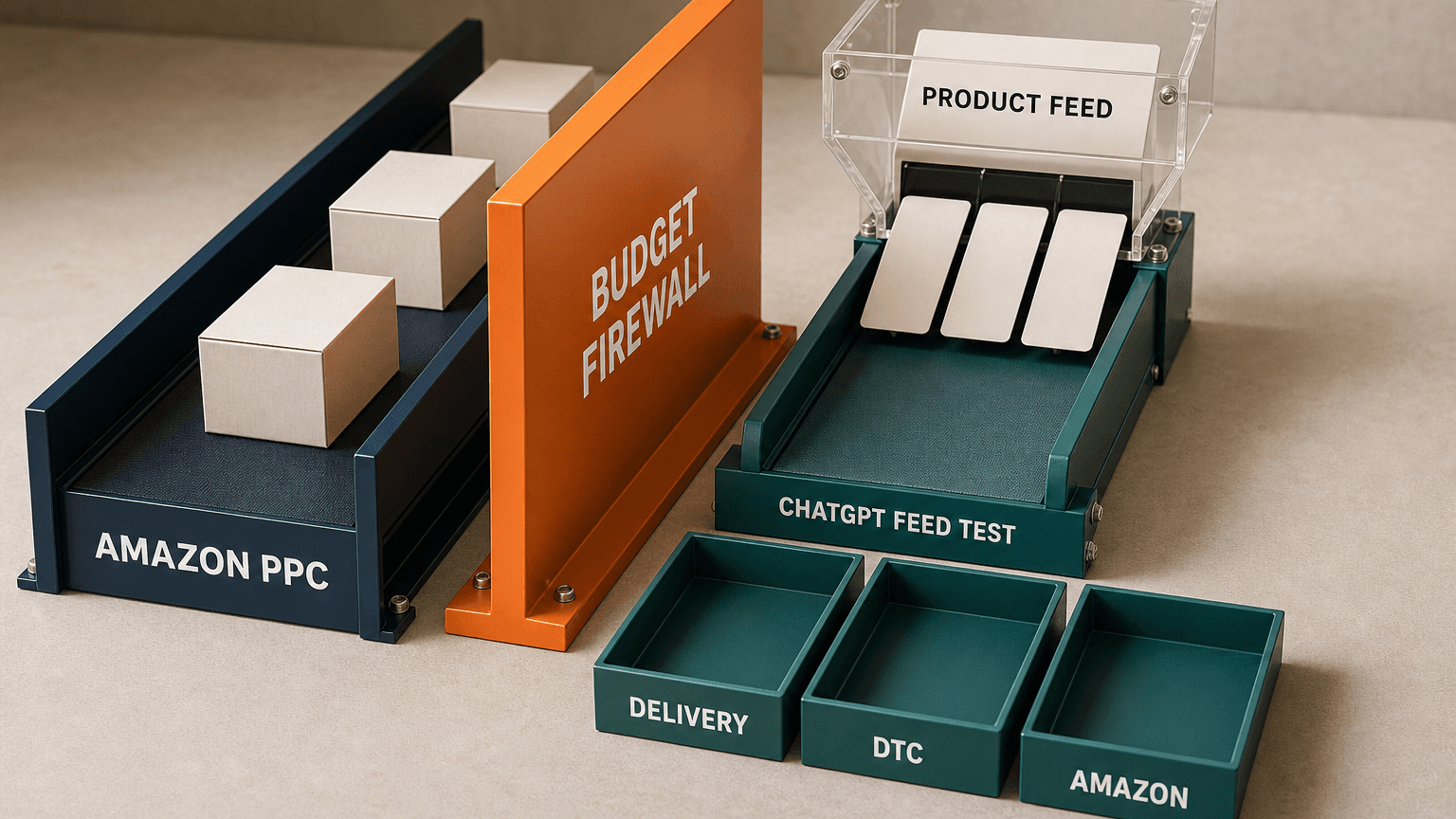
Amazon-first brands should test ChatGPT product-feed ads only if they also control a usable DTC catalog, product destination, and conversion-measurement stack. If you sell only on Amazon, cannot confirm Ads Manager access, or would need to cut productive Amazon campaigns to fund the test, wait.
The format is real. OpenAI now documents a product_feed campaign mode that selects eligible products from a merchant catalog and builds ads from feed data. The feed connection is created in Ads Manager, while catalog files are delivered through SFTP. [S1]
Access is still gated. OpenAI's developer guide requires an ad account eligible to create ads, a product feed linked to that account, the feed ID shown in Ads Manager, and an Ads API key issued from the account. [S1] That makes this a readiness decision, not a land-grab emergency.
What OpenAI shipped, and what it did not
A product-feed campaign separates the job into four parts:
- The feed supplies current product data.
- The campaign sets budget, schedule, targeting, and product-feed mode.
- The product set filters which items may serve.
- The template turns the selected item's feed values into an ad. [S1]
OpenAI's developer documentation is narrower and more useful than the launch chatter. Each product set selects one linked feed, and the product-ad template fills the title, description, price, image, and destination from the selected product. Uploading a feed does not guarantee delivery; the product and campaign structure still have to be eligible, active, funded, and able to pass processing and review. [S1]
A fresh practitioner observation compared the format's product image, title, price, and rating treatment with Amazon Sponsored Products. [S9] The resemblance is useful for explaining the card. It does not mean the auctions, audiences, attribution, or economics are interchangeable.
Amazon Sponsored Products promote eligible Amazon listings, run on a cost-per-click model, and send the shopper to an Amazon product-detail page. [S6] ChatGPT product-feed ads use a separate account, feed, destination, and measurement system. Treat them as separate channels from the first spreadsheet row.
Pass the eligibility gate before touching the budget
The first test is not an ad. It is whether the brand can responsibly run one.
Confirm all of the following:
- The business can open Ads Manager. Confirm that the account is eligible to create ads and exposes the feed ID and API-key setup required by OpenAI's developer guide. [S1]
- The account exposes product feeds. You need the Feeds area, a linked feed ID, SFTP credentials, and the Product feed campaign type. [S1]
- The brand controls a compliant destination. OpenAI's schema requires a product URL, seller URL, image, price, availability, return-policy URL, and country data. [S2]
- The measurement stack works before launch. Install the OpenAI pixel and, where practical, the server-side Conversions API. Use the same event identifier to deduplicate browser and server versions of one conversion. [S5]
- The test has its own money. It should not depend on cutting an Amazon campaign that is meeting its profit and growth job.
Direct purchase inside ChatGPT is not the same thing as ad eligibility. OpenAI uses separate fields for is_eligible_checkout and is_ads_eligible. [S2] A brand can therefore evaluate ads without assuming it must enable in-ChatGPT checkout.
That does not settle the Amazon-only question. The public documentation does not say whether an Amazon marketplace listing will be accepted as the merchant's product and seller destination. If you do not control a DTC site, ask Ads Manager support to confirm your exact setup before building a feed. Do not treat an Amazon URL as a clever loophole until OpenAI accepts it.
Audit the feed like it is the ad creative
In this format, feed quality is creative quality. OpenAI pulls the product title and description from the feed, while the selected item supplies the image and destination URL. [S1]
For the first product set, choose a coherent group with one commercial hypothesis. It might be a product line, margin tier, use case, or inventory position. Do not dump the whole catalog into one ad group simply because the platform can ingest it.
Check each included item for:
- a title that identifies the product without keyword soup;
- a description that explains the actual use case and differentiators;
- an accurate image, price, currency, and stock state;
- a working product page that matches the feed;
- current seller, return-policy, and country information;
is_ads_eligible=trueonly where the item is genuinely ready to advertise. [S2]
OpenAI supports product-set filters on documented feed fields. Use them to isolate a coherent test group instead of rewriting product titles to force campaign structure. [S1]
Before launch, confirm the linked feed, eligibility fields, filters, campaign mode, active status, budget, and schedule. After launch, use product-segmented insights to verify which item IDs actually receive impressions and clicks. [S1]
Build three measurement lanes
One blended dashboard will hide the answer. Keep delivery, DTC outcomes, and Amazon performance separate.
| Measurement lane | What to inspect | Decision it supports |
|---|---|---|
| OpenAI delivery | Product impressions and product clicks by item ID | Is the feed serving, and which products receive traffic? |
| DTC outcomes | Tagged sessions, product-page behavior, orders, revenue, contribution margin, cancellations and returns | Is the traffic creating profitable customer activity on the brand's site? |
| Amazon baseline | Sponsored Products spend, sales, conversion, ACOS or contribution margin, plus the brand's broader profitability measure | Did the experiment leave the proven Amazon engine intact? |
OpenAI documents product-segmented insights for feed ID, item ID, title, impressions, and clicks. [S1] It also provides a pixel and Conversions API for outcome measurement. [S5] A current retail-practitioner analysis still recommends checking native reporting against first-party analytics and CRM data because reporting workflows and controls are developing. [S8]
Decide the conversion event, margin rule, test budget, and stopping conditions before the first click. Do not invent a universal learning window. Set a review period that fits the brand's normal conversion volume, then resist declaring victory or failure from a handful of clicks.
If the ad sends shoppers to Amazon rather than a DTC store and OpenAI confirms that destination is allowed, Amazon Attribution may help eligible sellers measure the on-Amazon effect of the off-Amazon campaign. [S7] It does not replace DTC analytics when checkout happens on the brand's own site.
Put a firewall around Amazon PPC
The clean funding rule is simple: create a separate experimental pool. Do not raid a productive Amazon campaign because ChatGPT has a new interface and a promising noun.
This matters because Amazon Sponsored Products already has a defined retail destination, product eligibility rules, budget controls, and account history. [S6] The new channel does not need to beat Amazon on day one. It needs to produce enough trustworthy data to justify another test without damaging the business that paid for the learning.
Keep these controls in place:
- Give the ChatGPT test its own campaign budget and ledger line.
- Hold the Amazon baseline stable unless an Amazon-side reason requires a change.
- Do not compare platform-reported ROAS without checking attribution logic, revenue source, returns, and margin.
- Record feed changes, landing-page changes, and measurement fixes so the operator knows what caused the next result.
- Scale only after both delivery data and first-party economics make sense.
This is the same discipline behind a good Amazon PPC scale-readiness review: prove that budget, placement capacity, and margin can support the next move before increasing exposure.
Use a scale, repair, or stop decision
At the end of the planned test window, choose one lane.
Scale when the feed is stable, conversion events are trustworthy, contribution economics meet the brand's pre-set rule, and Amazon performance did not deteriorate because of the experiment.
Repair when delivery is weak but the cause is visible: rejected items, stale availability, mismatched landing pages, thin descriptions, broken conversion events, or a product set that mixes unrelated items.
Stop when access remains uncertain, measurement cannot reconcile, the destination is not accepted, margin fails the pre-set rule, or the team can only continue by starving a proven channel.
None of these decisions requires pretending the channel is mature. Treat the first run as a bounded learning test and stop if its data cannot support the next decision.
The practical answer for Amazon-first brands
Brands with a controlled DTC catalog can prepare now: confirm account access, clean a coherent product set, install conversion measurement, and define a separate learning budget.
Amazon-only sellers should wait for explicit destination approval. Brands with messy feeds or weak analytics should fix those systems first. A new ad channel is a poor place to discover that price, inventory, and order events disagree in three databases.
And no, this does not replace the work described in Amazon Ads MCP Server Explained. MCP concerns agents accessing Amazon Ads tools. Product-feed ads concern buying media inside ChatGPT. Same AI neighborhood, different plumbing.
Before moving meaningful spend into an experimental commerce channel, protect the channel already carrying demand. Clickbringer can review the structure, measurement, and profit controls inside your Amazon PPC program. If you want a clear baseline before funding the test, request a free Amazon PPC audit.
Sources
[S1] Product feeds – Ads, OpenAI Developers, accessed July 18, 2026.
[S2] Products – Agentic Commerce, OpenAI Developers, accessed July 18, 2026.
[S5] Conversions API – Ads, OpenAI Developers, accessed July 18, 2026.
[S6] Sponsored Products, Amazon Ads, accessed July 18, 2026.
[S7] Amazon Attribution, Amazon Ads, accessed July 18, 2026.
[S8] What the latest ChatGPT Ads updates mean for retail, Lydia Wigley, Croud, July 9, 2026, accessed July 18, 2026.
[S9] ChatGPT has a new ad format specifically for ecommerce, Juozas Kaziukėnas, July 16, 2026, accessed July 17, 2026.


